


Why Smart Sellers Are Moving Away From “Amazon First” Thinking (and Building Social Media Systems Instead)
The illusion of “easy e-commerce”
A lot of new sellers enter e-commerce with the same starting belief:
“I’ll just use AI to create product images, write descriptions, list on Amazon, and start selling.”
On the surface, it sounds logical. Tools are better than ever. Content creation is faster than ever. Platforms like Amazon feel like ready-made traffic machines.
But what most people don’t see is what happens after the listing goes live.
Suddenly, the business is no longer about “creating a product page.”
It becomes about:
- ad spend management
- keyword competition
- listing suppression rules
- account health monitoring
- inventory pressure
- compliance reviews
- constant optimization just to stay visible
Amazon isn’t a plug-and-play marketplace. It’s an operating system with strict rules and very little forgiveness for mistakes.
And for beginners, that gap between expectation and reality is where most frustration starts.
The hidden cost most beginners underestimate
What makes Amazon attractive is also what makes it risky: everything depends on the platform.
You don’t control:
- traffic
- ranking stability
- account status
- visibility rules
- policy enforcement
Even if your product is good, your business can still be interrupted by factors you didn’t directly cause.
Many sellers eventually experience:
- listings getting suppressed
- sudden ranking drops
- account warnings or reviews
- unexpected ad cost spikes
And when that happens, the “simple business idea” starts feeling a lot more fragile.
The issue isn’t Amazon itself — it’s dependency.
A quiet shift happening in 2026 e-commerce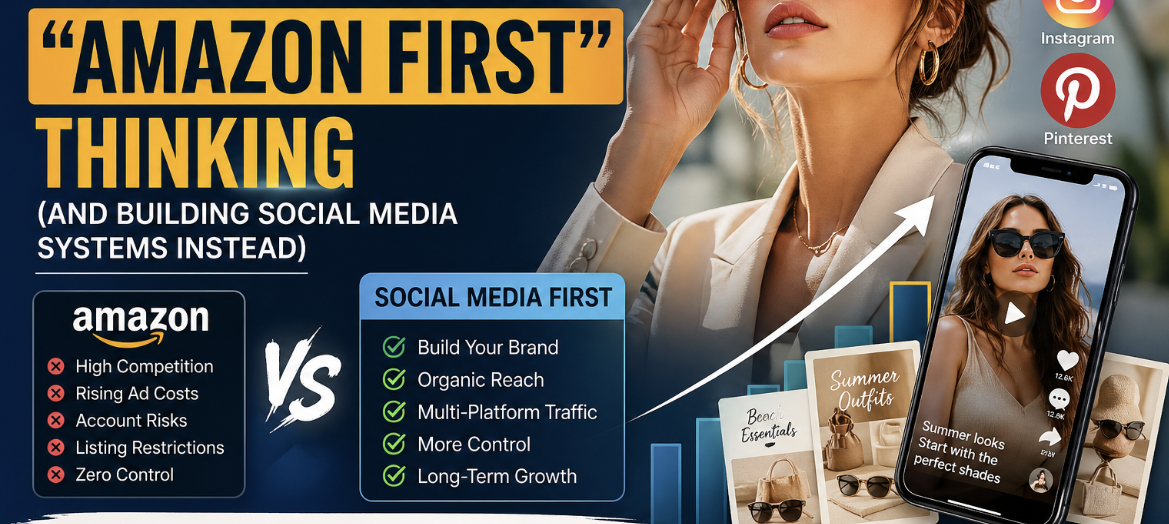
A different pattern is emerging among newer sellers and small brands:
Instead of starting on marketplaces first, they’re starting with attention first.
That means:
- TikTok short videos
- Instagram Reels
- Pinterest discovery content
The goal is not immediate listing optimization.
The goal is demand creation.
Because attention behaves very differently from marketplace traffic:
- It’s algorithm-driven, not bid-driven
- It scales organically when it hits
- It builds brand recognition before purchase intent
In other words, instead of “hoping people find your listing,” sellers are now creating the conditions where people already want the product before they see it on a marketplace.
Why social media became the new “first layer”
Social platforms changed the structure of e-commerce discovery.
A product like women’s sunglasses, for example, doesn’t need explanation — it needs exposure:
- outfit transformations
- lifestyle visuals
- seasonal aesthetics
- quick try-on clips
These formats travel naturally across:
- TikTok (virality)
- Instagram (branding)
- Pinterest (search + inspiration)
This creates something powerful:
Instead of relying on one platform for traffic, sellers build a multi-source attention loop.
And once that loop exists, conversion becomes easier — whether it’s Shopify, Amazon, or any other store.
The real advantage: control over distribution
Here’s the core difference:
Marketplace-first approach:
You depend on one system to bring you customers.
Social-first approach:
You build your own demand pipeline, then decide where to convert it.
That second approach gives sellers something Amazon alone can’t offer:
Control over visibility.
And in modern e-commerce, control is often more valuable than convenience.
Why consistency beats “perfect setup”
A lot of beginners get stuck trying to build the “perfect store”:
- perfect product images
- perfect listings
- perfect launch timing
But attention doesn’t reward perfection — it rewards repetition.
The sellers who win are usually not the most creative ones.
They’re the most consistent ones.
They keep showing up across platforms long enough for the algorithm to recognize patterns and start distributing their content.
How this actually gets managed in practice
This is usually the point where things get real.
Once you start posting across TikTok, Instagram, and Pinterest at the same time, you quickly realize the problem isn’t ideas — it’s consistency.
You miss a day, momentum drops.
You try to “catch up,” but the flow is already gone.
That’s where systems like JarveePro actually make sense.
Not as some “growth hack,” but as a way to keep things moving when you can’t manually keep up with everything.
Because the workload isn’t just posting once — it’s repeating it across platforms, formats, and schedules without falling off track.
And that’s usually the real breaking point for most people.
It’s not motivation that runs out first.
It’s time.
And when time becomes the limit, structure quietly becomes the advantage.
You don’t need to choose one path forever
This is important:
This isn’t about “Amazon vs social media.”
It’s about sequence.
Many successful sellers eventually use both:
- social media to create demand
- marketplaces to capture demand
But the order matters.
Starting with attention first reduces pressure, lowers risk, and gives you more flexibility in where and how you sell.
Conclusion
E-commerce is no longer just about listing products online.
It’s about building visibility before the sale ever happens.
And while Amazon still plays a major role in the ecosystem, relying on it as the starting point puts most beginners into a system they don’t fully control.
That’s why more sellers are changing the entry point entirely.
They’re starting with attention, not listings.
With content, not catalogs.
With systems, not single platforms.
And even something as simple as testing a free setup with JarveePro can help you understand what that shift actually feels like in practice — before you ever commit to scaling it.
Because once you see how distribution works outside of marketplaces, you don’t really think about e-commerce the same way again.
You stop asking “where do I list this?”
And start asking:
“How do I make this visible everywhere people already are?”