


Why Do My Accounts Still Get Detected Even With Anti-Detect Browsers?
Introduction
A lot of users assume that once they start using an anti-detect browser, they become invisible to platform systems.
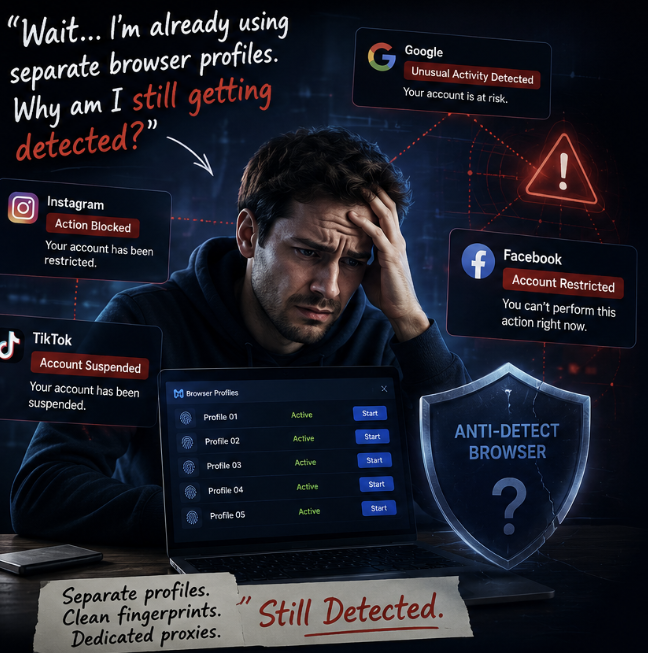
So when accounts still get flagged, restricted, or linked together, the reaction is usually confusion:
"Wait… I'm already using separate browser profiles. Why am I still getting detected?"
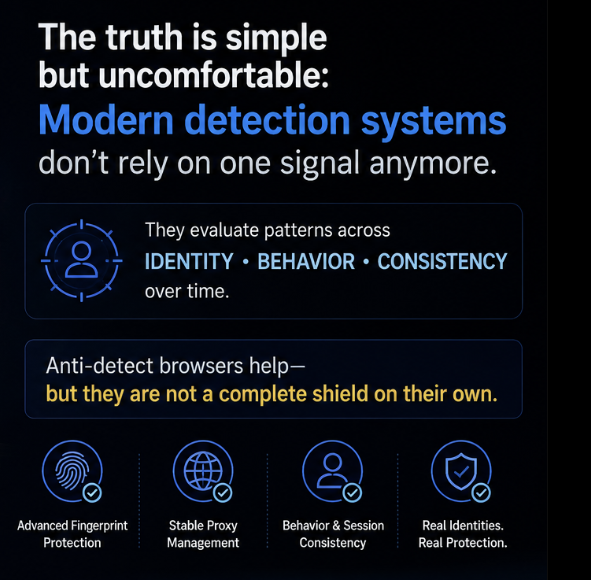
The truth is simple but uncomfortable: modern detection systems don't rely on one signal anymore. They evaluate patterns across identity, behavior, and consistency over time.
Anti-detect browsers help—but they are not a complete shield on their own.
The Real Problem: Detection Is No Longer Just About Fingerprints
In earlier years, separating browser fingerprints was often enough to reduce risk significantly.
In 2026, platforms like Instagram, TikTok, and Google use layered detection models that combine:
Browser fingerprint analysis
IP reputation and network consistency
Behavioral patterns (timing, navigation flow, session habits)
Cross-session correlation signals
Device and environment stability over time
This means even perfectly isolated browser profiles can still appear connected if surrounding signals don’t match natural human behavior.
Why Accounts Still Get Detected
Even with anti-detect browsers, detection usually happens due to a combination of small but repeating issues:
1. Behavioral similarity across profiles
If multiple accounts behave in similar timing patterns or engagement rhythms, systems can correlate them—even if fingerprints differ.
2. Proxy and profile mismatch
A clean browser profile connected to an unstable or mismatched network environment creates inconsistency signals.
3. Too-structured activity patterns
Automation that runs too evenly (same delays, same sequences, same session lengths) becomes easier to classify.
4. Lack of profile "history depth"
New or frequently reset profiles often lack behavioral continuity, which makes them easier to flag.
5. Cross-account repetition
Reusing similar actions, targets, or browsing patterns across multiple accounts increases correlation risk.
The key insight: modern detection is probabilistic, not binary.
The Shift: From Fingerprints to Behavior Systems

The biggest change in recent years is that platforms no longer ask:“Is this device unique?”
They now ask:“Does this look like a real user over time?”
That includes long-term signals such as:
session consistency
browsing diversity
engagement randomness
account lifecycle behavior
This is why even well-configured setups can still experience detection issues if behavioral realism is missing.
Where Most Anti-Detect Setups Fall Short
Most setups focus heavily on:
fingerprint isolation
proxy rotation
profile separation
But they often underinvest in:
behavioral variation
session realism
identity continuity over time
In other words: the technical layer is strong, but the behavioral layer is weak.
That gap is where detection still happens.
A More Complete Approach: Structured Identity + Behavior Management
This is where modern multi-profile browser systems become more relevant—not just for separation, but for structured management of identities over time.

One example is MarketerBrowser, which is designed around managing multiple browser environments with stronger emphasis on:
isolated profile environments
consistent identity retention per profile
structured session management
proxy-to-profile stability alignment
controlled multi-account workflows
Instead of treating each profile as a one-time container, the focus shifts to building long-lived, believable identity environments.
Use Case
A common scenario looks like this:
An agency managing multiple brand accounts notices that:
accounts are not being linked directly
but engagement drops or restrictions still occur intermittently
After auditing the setup, the issue is usually not fingerprint duplication—it's:
similar posting patterns across accounts
identical browsing and interaction timing
unstable session history resets
inconsistent proxy alignment
By restructuring profiles into stable identity units and introducing variability across behavior patterns, many operators report improved consistency in account stability over time.
The key change is not "hiding better," but behaving differently per identity.
What a Modern High-Trust Setup Actually Looks Like
A strong setup in 2026 usually includes:
One profile = one long-term identity
Stable proxy mapping per profile
Natural variation in session timing
Unique behavioral patterns per account
Avoidance of synchronized actions across profiles
Gradual account maturity instead of resets
The goal is not perfection—it's realism.
Conclusion
If accounts are still getting detected while using anti-detect browsers, the issue is rarely the browser itself.
It's usually the missing layer above it: behavior, consistency, and long-term identity structure.
Anti-detect tools solve isolation.
But sustainable operation depends on how realistic each profile behaves over time.
In modern systems, invisibility is not about being separate—it's about being believable.
