


AI, Social Media Security & Why Fingerprint Browsers Matter
AI Made Automation Easy. Social Platforms Made Trust Harder.
As artificial intelligence transforms social media marketing, businesses face a new challenge: managing digital identities in an environment where platforms are increasingly focused on authenticity, security, and automated behavior.
Artificial intelligence has dramatically reduced the cost of producing content and automating online workflows.
A marketing team can now generate hundreds of content variations, analyze audience conversations, develop campaigns, and automate repetitive activities with tools that were unimaginable just a few years ago.
What once required a large team can increasingly be supported by a handful of employees and AI systems.
But there's another side to this transformation.
When automation becomes accessible to everyone, social media platforms must also respond to the growing volume of automated activity, spam, impersonation, and account abuse.
For legitimate businesses managing multiple accounts, this creates a new operational challenge.
AI makes it easier to scale activity. But scaling activity does not automatically make accounts more trustworthy.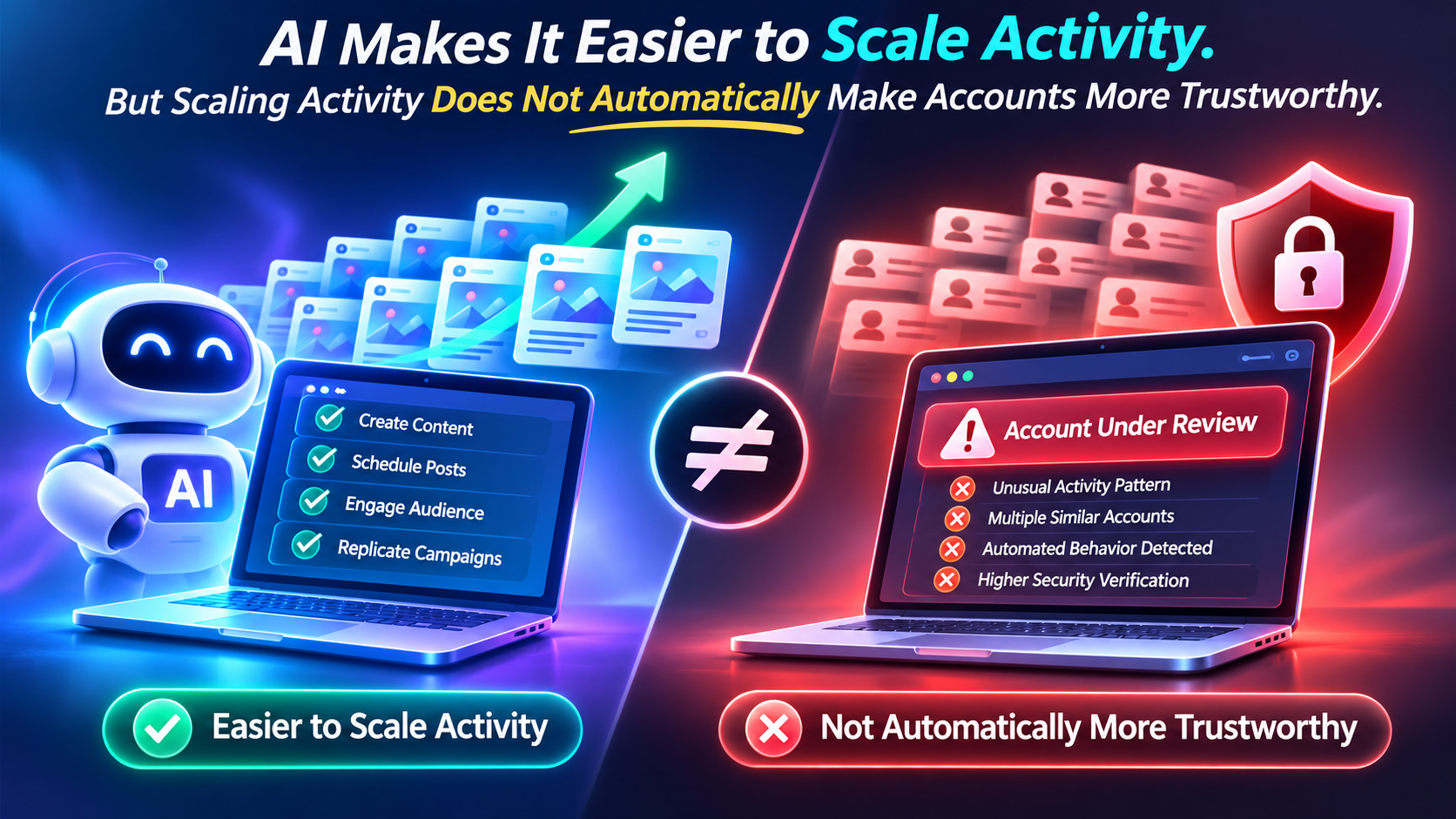
The companies that understand this distinction will be better prepared for the next generation of social media operations.
1. The AI Revolution Has Changed Both Sides of Social Media
Most discussions about AI in marketing focus on productivity.
AI can help businesses write content, generate images, analyze competitors, identify market opportunities, and coordinate publishing schedules.
These capabilities are valuable.
But the same technologies can also be misused to generate spam, manipulate engagement, impersonate users, and operate deceptive account networks.
Social media platforms therefore have strong incentives to invest in systems that identify suspicious behavior and protect their users.
These systems may examine a combination of signals, including account history, unusual activity patterns, network characteristics, authentication events, and device or browser information.
Not every platform discloses the details of its detection systems, and increased security cannot be attributed to AI proliferation alone.
Nevertheless, the broader direction is clear: as automated online activity becomes more capable, account integrity and platform security become increasingly important.
For businesses, the challenge is no longer simply how to automate more work.
It is how to build reliable, responsible systems for managing that work.
2. The Hidden Problem With Managing Hundreds of Social Media Accounts
Consider a marketing agency managing accounts for 100 different businesses.
Its clients may operate across Facebook, Instagram, TikTok, X, LinkedIn, Reddit, and other platforms.
Each account represents a separate business identity, audience, publishing strategy, and operational responsibility.
The agency may have several employees and AI-powered tools working across these accounts.
Without a structured browser environment, everyday operations become complicated.
Employees may open the wrong account, mix browser sessions, lose access to saved settings, or encounter unexpected authentication requirements.
These problems are not necessarily evidence of platform detection.
They are often consequences of poorly organized account infrastructure.
A business managing hundreds of accounts needs more than a collection of usernames and passwords.
It needs a reliable system for separating accounts, maintaining browser environments, assigning responsibilities, and monitoring operations.
This is where specialized browser profile management becomes relevant.
3. Why Your Browser Identity Matters
When you visit a website, the platform does not necessarily see only your username and IP address.
Modern browsers expose technical characteristics that websites may use for compatibility, security, analytics, and fraud prevention.
These can include:
| Browser signal | What it represents |
|---|---|
| Operating System | Reported platform environment |
| Browser Version | Browser capabilities and release information |
| User Agent | Browser identification information |
| Canvas | Graphics rendering characteristics |
| WebGL | Graphics capabilities and rendering behavior |
| Audio | Audio processing characteristics |
| Fonts | Font availability and rendering |
| Screen Resolution | Display environment |
| Device Pixel Ratio | Display scaling characteristics |
| Language and Timezone | Localization settings |
| WebRTC | Browser communication and some network-related information |
Collectively, some of these signals can contribute to a browser fingerprint.
A browser fingerprint is not the same as a login identity, and it does not necessarily identify a person uniquely.
However, it can be one component of a broader technical environment that websites observe.
For businesses operating multiple authorized accounts, understanding browser fingerprints is useful because it helps them manage consistent, reproducible browser environments.
The purpose of professional browser identity management should be consistency and control—not the promise of invisibility.
4. Why Incognito Mode Is Not Enough for Professional Multi-Account Management
Many people assume that opening an incognito window creates a completely separate digital identity.
It doesn't.
Private browsing primarily changes how certain browsing data is retained locally.
It does not automatically provide a separate operating-system environment, change the public IP address, or eliminate browser fingerprinting.
For an individual browsing occasionally, incognito mode may be sufficient.
For a company managing hundreds of distinct business workspaces, it is not a complete management solution.
Dedicated browser profiles provide a more structured approach.
Each profile can maintain its own supported browser storage, session data, and configuration.
This helps businesses separate unrelated projects and reduce accidental account mixing.
A dedicated browser profile is not a substitute for official platform permissions or security policies, but it can make complex operations easier to organize.
5. The Real Value of an Anti-Detect Browser in the AI Era
The term anti-detect browser is often misunderstood.
Some marketing messages suggest that these tools make users invisible to websites or guarantee protection from account restrictions.
That is not how modern platform security works.
Websites can evaluate multiple signals, and no browser configuration guarantees that an account will be considered trustworthy.
The more useful business value of a specialized fingerprint browser is its ability to help manage distinct browser environments.
For example, a platform such as MarketerBrowser provides browser-profile management and configurable browser identity settings.
This can support businesses that need to organize different accounts, campaigns, or testing environments.
Instead of treating every business account as another tab in the same browser, users can create dedicated profiles with their own configurations and supported storage.
For agencies and enterprise teams, this provides a foundation for more structured operations.
The distinction is important:
A fingerprint browser helps manage the browser environment. It does not override platform rules, guarantee account trust, or make prohibited automation acceptable.
6. AI Agents Need Browser Infrastructure, Not Just Intelligence
Imagine an AI agent responsible for helping a marketing team monitor authorized social media accounts.
It may need to open a dashboard, review account information, prepare a report, or perform an approved workflow.
The AI model can interpret the task.
An automation framework can execute supported actions.
But the workflow still requires an appropriate environment.
That environment may need:
An isolated browser profile
A valid authenticated session
Browser storage
Consistent browser settings
Network connectivity
Account permissions
Error recovery
Human approval for sensitive actions
This is the missing layer in many discussions about AI automation.
Companies invest in smarter models while overlooking the infrastructure required for reliable execution.
When a business operates hundreds of accounts, browser management becomes an engineering and operational problem.
AI is the intelligence layer. Browser infrastructure is part of the execution layer.
7. The Difference Between Managing 10 Accounts and 1,000 Accounts
Managing ten accounts manually may be straightforward.
Managing one thousand accounts introduces entirely different requirements.
The company must consider how quickly browser profiles can open, how much memory they consume, how sessions are maintained, and how failures are handled.
It must also coordinate employees, account permissions, and automation workloads.
Consider the following operational requirements:
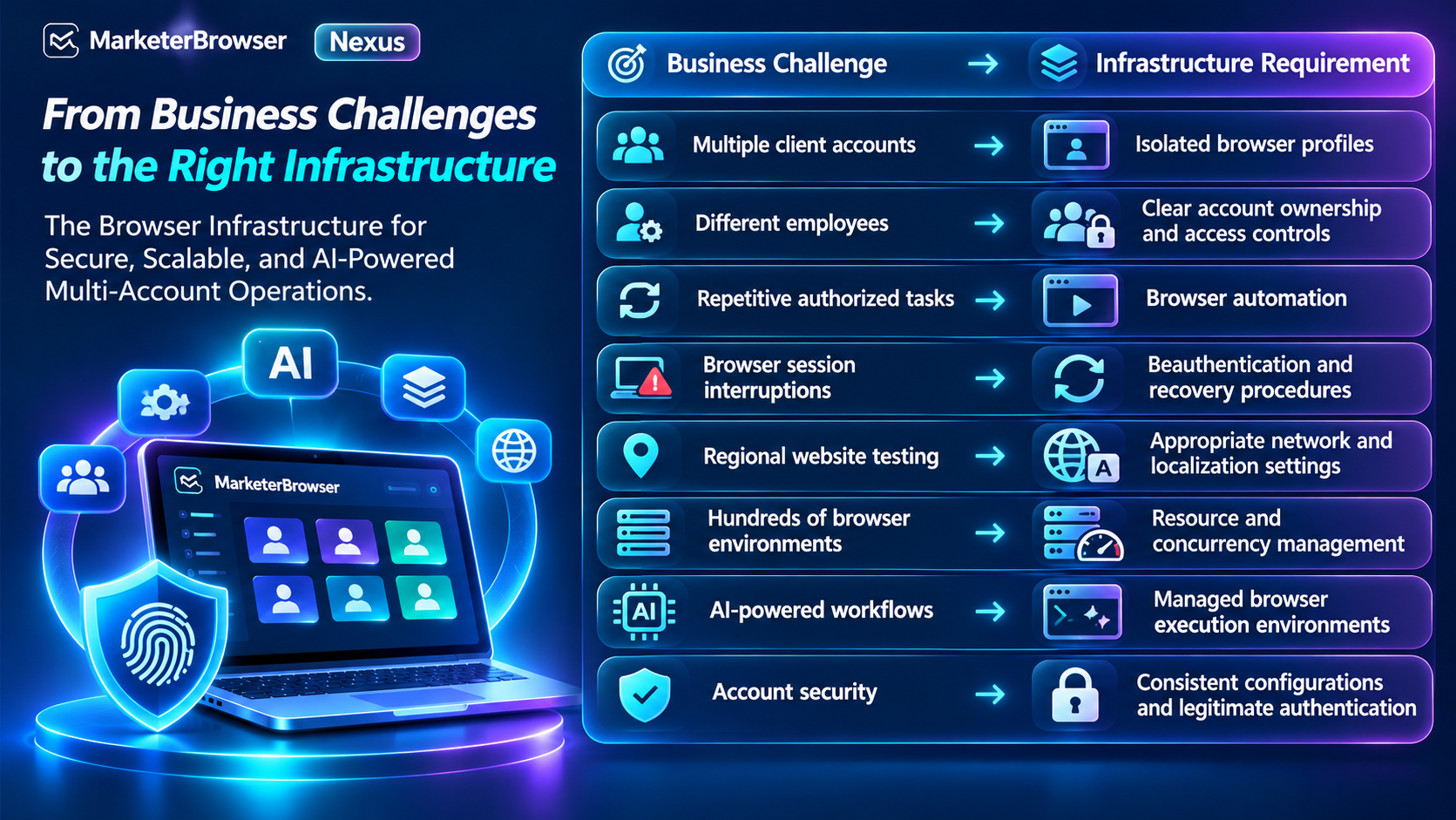
At this scale, success depends on more than automation capabilities.
It depends on operational reliability.
A company that manages fewer accounts efficiently may outperform a competitor operating thousands without proper organization.
8. Why Random Fingerprints Are Not a Business Strategy
One misconception about fingerprint browsers is that more randomization automatically means better protection.
In reality, browser characteristics are often related.
A browser configuration should make technical sense as a complete environment.
For example, browser version, operating system, User Agent, and Client Hints should be compatible with one another.
Arbitrarily changing unrelated settings can create inconsistent testing environments and make technical troubleshooting more difficult.
For legitimate business operations, consistency is generally more valuable than constant randomization.
A company should know which environment belongs to which account and be able to reproduce that environment when necessary.
This is particularly important for browser automation, web testing, and long-running business workflows.
9. MarketerBrowser Nexus: From Browser Profiles to AI Browser Operations
MarketerBrowser Nexus reflects a broader direction in browser management.
Instead of focusing only on individual browser profiles, its product direction incorporates browser identity configuration, team authentication, browser-data management, and automation-oriented capabilities.
These are relevant to businesses operating multiple digital workspaces.
For example:
Social media agencies can organize authorized client accounts into dedicated browser environments.
Affiliate marketing companies can separate campaign research, tracking, and reporting workspaces.
E-commerce businesses can organize store management, advertising, and customer operations.
AI automation teams can explore browser-based execution environments for supported workflows.
International businesses can maintain controlled environments for regional research and website testing.
The opportunity is not simply to create more browser profiles.
It is to establish a more reliable operational foundation for increasingly AI-driven work.
10. What Companies Should Do Before Scaling AI-Powered Account Operations
Before expanding from dozens to hundreds of accounts, businesses should examine their operational readiness.
First, confirm that the accounts and workflows are authorized under the relevant platform policies.
Next, establish clear ownership and access procedures.
Then organize browser profiles around business responsibilities rather than arbitrary account numbers.
Evaluate browser startup performance, session management, network reliability, and automation recovery.
Where official APIs are available, use them when appropriate.
For browser-based tasks, maintain consistent environments and appropriate human oversight.
Finally, measure actual business outcomes rather than simply counting accounts or automated actions.
The companies that benefit most from AI will not necessarily be those that automate the largest number of interactions.
They will be those that automate valuable work reliably.
11. The Next Competition Is Not Just AI Against AI
As AI models become more widely available, businesses may find it harder to differentiate themselves through access to intelligence alone.
The more interesting competitive advantage may emerge from how that intelligence is deployed.
A company with excellent AI models but unreliable browser operations can still struggle with failed tasks, session interruptions, and operational confusion.
Another company using comparable models with better execution infrastructure may achieve more consistent results.
This is why browser infrastructure deserves greater attention.
For businesses whose workflows depend on websites, browser identity management, session continuity, automation, and operational monitoring can become important capabilities.
They are not glamorous compared with the latest AI model.
But they are often where the real work happens.
Conclusion: AI Can Scale Your Work. Infrastructure Determines How Reliably It Runs.
The proliferation of AI has transformed digital marketing.
Businesses can now generate content, analyze information, and automate workflows at a scale that previously required far greater resources.
At the same time, platforms continue to invest in account security, integrity, and abuse prevention.
This makes reliable, compliant account management more important.
For companies managing multiple authorized accounts, a dedicated fingerprint browser can provide a valuable layer of organization and environmental control.
MarketerBrowser approaches this challenge through browser profile management, identity configuration, and automation-oriented capabilities.
The strategic opportunity goes beyond traditional anti-detect browser functionality.
In the AI era, the companies that compete most effectively may be those that combine intelligence with dependable execution infrastructure.
Explore MarketerBrowser
Building an AI-powered business requires more than selecting the right AI model.
It also requires the right environment for the work.
Explore MarketerBrowser for browser profile management, configurable browser identities, and automation-oriented workflows.
Official Website: https://www.marketerbrowser.com/
MarketerBrowser Nexus — Browser Infrastructure for AI-Driven Operations.